
Church financial reporting: what to review monthly
What should church leaders review each month? Five key numbers, a sample report with three problems, and a ten-minute way to read it.

Church financial reporting is the process of rewriting a church's records into a report that is sent out to church leaders on a monthly basis so that they can read it and discuss its contents. After all, a report nobody can read is just a pile of numbers.
When the financial reporting process is functioning well, a member of the board takes one look at the report and either says, “Everything seems fine,” or, “We need to discuss the youth budget.” When church financial reporting does not function well, the church treasurer hands out a report that consists of several pages, and nobody asks any questions.
This guide describes five good numbers worth checking at least once a month, a ten-minute way to go through the report, and the checklist for the treasurer at the end of the month. There will also be a sample report with a couple of issues in it for you to figure out before we point them out.
Key takeaways
-
Church finance reporting helps convert the financial data into a brief report that can be used for making decisions.
-
Five numbers can make an excellent starting point of the report: revenue, expenses, profit or loss, available cash for near-term bills, and evaluated funds.
-
A single bank account balance can be misleading; it should be divided between free cash and money that was earmarked for some need.
-
Ten minutes is enough time to check the report that is one page long and has a note at the top.
-
The treasurer should send the report to the board in advance.
What is church financial reporting, and how is it different from bookkeeping?
The process of church financial reporting keeps track of a church's financial history. All the money a church takes in and spends is recorded as transactions. Reporting takes the bookkeeping records and provides the valuable information needed to make good decisions about finances.
Bookkeeping creates records, while reporting provides the useful output. If the records are inaccurate, the reports won't do you much good, which is why it is best to start with our guide on church bookkeeping. Even accurate records are useless if leaders will not even take the time to read the reports.
Who reads the church’s financial reports, and what do they need?
Different readers have varying requirements for information they get. One report will not benefit all.
|
Reader |
Information needed |
Frequency |
|
Board of directors and finance team |
The complete report covering income and spending, surplus or deficit, funds and cash |
Every month in written format |
|
Pastor |
A one-page summary with the main figure available in cash and anything requiring a decision |
Monthly |
|
Ministry leader |
Numbers specific to their own ministry (budget, actual figures, remaining) |
Monthly |
|
Congregation |
Plain report containing income, spending, and fund results |
Once or twice a year |
Start with the complete report for the board and then make necessary changes for other readers. Our guide on church financial management covers the yearly summary for the congregation, so this post stays focused on the monthly reporting
Launch your church into the future
Everything your ministry needs — giving, events, members, and more. Try it free, no credit card required.
Start Free Trial No credit card • Cancel anytimeWho reads the church’s financial reports, and what do they need?
Understanding five figures to give you a good monthly overview of your church's finances: income versus budget; expenditure versus budget per ministry; surplus or deficit; cash in the bank and pending bills; and restricted funds. These figures should give you a starting point rather than a definitive rule. For a small church, it may suffice to just analyze three key figures at first.
|
Number |
Value |
Questions to ask |
Red flag |
|
1.Income versus budget |
Whether giving is as expected |
Is this a one-off dip or a trend? |
Income is below budget for two months in a row |
|
2.Expenditure versus budget per ministry |
Which ministry is going over budget |
Who approved the extra expenses and can we expect more? |
Ministries have spent most of their budget early |
|
3.Surplus or deficit, month and year |
Whether church is spending more than it receives |
Does year-to-date figure tell a different story? |
Deficit continues to increase month on month |
|
4. Available cash compared with upcoming bills |
Is the church able to make its required payments? |
What payments are due within the next 30 days, and is the cash available to make them? |
There is not enough cash to satisfy upcoming obligations |
|
5. Restricted fund balances |
How many funds are designated for a particular purpose? |
What portion of the company’s funds can be spent freely? |
Restricted funds may be misused that were previously restricted or a fund could be running a deficit which needs investigation |
The method for comparing actual figures with a budget is in our church budget guide. Here, we focus on what the comparison tells you.

What are the two main church financial statements, in plain words?
Churches usually have two reports that provide answers to two different questions.
-
Statement of Activities (Accounts Statement): It tells us what has happened in the period. It shows income and expenditure.
-
Statement of Financial Position (Balance Sheet): It shows where the church stands on any particular date. It has details of the church's assets, liabilities, and net worth.
One covers a period of time; the other is a snapshot of a single day.
The difference between what a church owns and what it owes is called net assets or fund balances, depending on the accounting framework used. Some funds may be restricted or designated for particular purposes, so the total balance may not mean all the money can be used for day-to-day operational activities. The Canadian Council of Christian Charities explains this in its guide to understanding and reading financial statements, which also highlights the importance of board members understanding these reports.
The statement names and reporting requirements differ from country to country, and some larger churches may also prepare a statement of cash flows. Ask your treasurer which statements are appropriate for your church.
What does a sample monthly church financial report look like?
The following report is intended for a 1-page church community of about 80 members. All numbers and figures given here are indicative only. Take your time to read through it as if you were a member of the church board, and see if you are able to detect three mistakes before reading the next section.
Monthly financial report: month ending 30 September
|
Income |
Budget (₹) |
Actual (₹) |
Difference (₹) |
|
Tithes |
50,000 |
41,000 |
9,000 under |
|
General offerings |
20,000 |
18,500 |
1,500 under |
|
Special gifts |
10,000 |
10,000 |
On target |
|
Hall rent |
5,000 |
5,000 |
On target |
|
Building fund gift |
0 |
50,000 |
50,000 over |
|
Total income |
85,000 |
1,24,500 |
39,500 over |
|
Spending |
Budget (₹) |
Actual (₹) |
Difference (₹) |
|
Pastor support |
35,000 |
35,000 |
On target |
|
Utilities |
7,500 |
8,000 |
500 over |
|
Repairs and maintenance |
6,500 |
5,000 |
1,500 under |
|
Missions and outreach |
13,500 |
13,500 |
On target |
|
Youth and children |
5,000 |
14,000 |
9,000 over |
|
Worship and sound |
4,000 |
3,500 |
500 under |
|
Administration |
3,500 |
3,000 |
500 under |
|
Annual events |
5,000 |
5,000 |
On target |
|
Reserve |
5,000 |
5,000 |
On target |
|
Total spending |
85,000 |
92,000 |
7,000 over |
- Surplus for the month: ₹32,500
- Bank balance at month-end: ₹3,20,000
- Bills and payments due in the next 30 days: ₹85,000
Treasurer’s note📌: The revenue this month exceeded the budget due to a ₹50,000 donation for the building fund. The youth camp was held in September. The account has a good balance.
Every figure in that note is correct but does not tell the board anything about the problem. Here are three issues the board needs to examine.
Problem 1: Donations are Falling Short of Expectations
Tithes and offerings made up ₹59,500 in comparison to the estimated amount of ₹70,000. The shortfall is ₹10,500, which equals about 15% of the expected amount. In the income statistics, this is obscured by the building fund contribution, which causes the total income to be higher than expected.
What to do: Assess giving in the previous three months before jumping to conclusions. If giving was strong before, it is probable that summer vacations are now getting in the way. If the trend continues, find out from the pastor if something has changed.
Problem 2: A ministry went over the limit
Youth and children spent ₹14,000 instead of the planned ₹5000. Hence, over expenditure of ₹9000, nearly three times over budget for one event.
What to do: Find out who approved the camp expenditure, and whether the youth leader has been informed about the limit. Then take the proper decision either to get the board to approve the changes to the budget, transfer the available money from an item that is flexible, or to let the youth leader know what is left until the end of the year. It is definitely not right to keep quiet and allow the ministry to repeat the mistake again.
Problem 3: The bank balance looks healthy, but most is spoken for
The bank balance is at ₹3,20,000, of which ₹2,00,000 is the building fund and ₹60,000 is the reserve. Only ₹60,000 is available for general operations, with ₹85,000 of bills due in the next 30 days. This creates a potential shortfall of ₹25,000 in available cash for general expenses.
The reported surplus of ₹32,500 should also be noted as, after excluding the ₹50,000 building fund donation, the church has an operating deficit of ₹17,500 for the month, assuming the remaining income and expenditures are related to operations.
What to do: The bank balance should be reported by fund and include available cash beside projected expenses in every report. Restricted funds should not be used for any purpose other than the restriction allows.
How can a leader review the report in ten minutes?
You don’t need to read every line, but work through the report in this order
1. Verify the fundamentals (one minute). Where is the reporting month and date? Did the treasurer reconcile the bank account? Our bookkeeping guide explains how the check works.
2. Read the note and then look at the bottom line (two minutes). Check the result of both the monthly results and the year-to-date figures, so that you can clearly see if the problem is crucial or temporary.
3. Split the cash (two minutes). How much was spent on general expenses ? How much is designated for a particular project? How much is kept as reserves?
4. Scan the difference column (two minutes). Do you see any big gap between what was in the budget and what was earned or spent? The board may put up a limit, such as up to 10%, to indicate items for review. Agreeing on this limit in advance may help set standards.
5. Asking questions (two minutes). Questions to ask your treasurer and questions to ask the ministry leader responsible for the largest unexpected difference.
6. Your next step (one Minute). You take a decision not to decide, seek additional information, or to delete one reply. Record the decision and all actions in the minutes.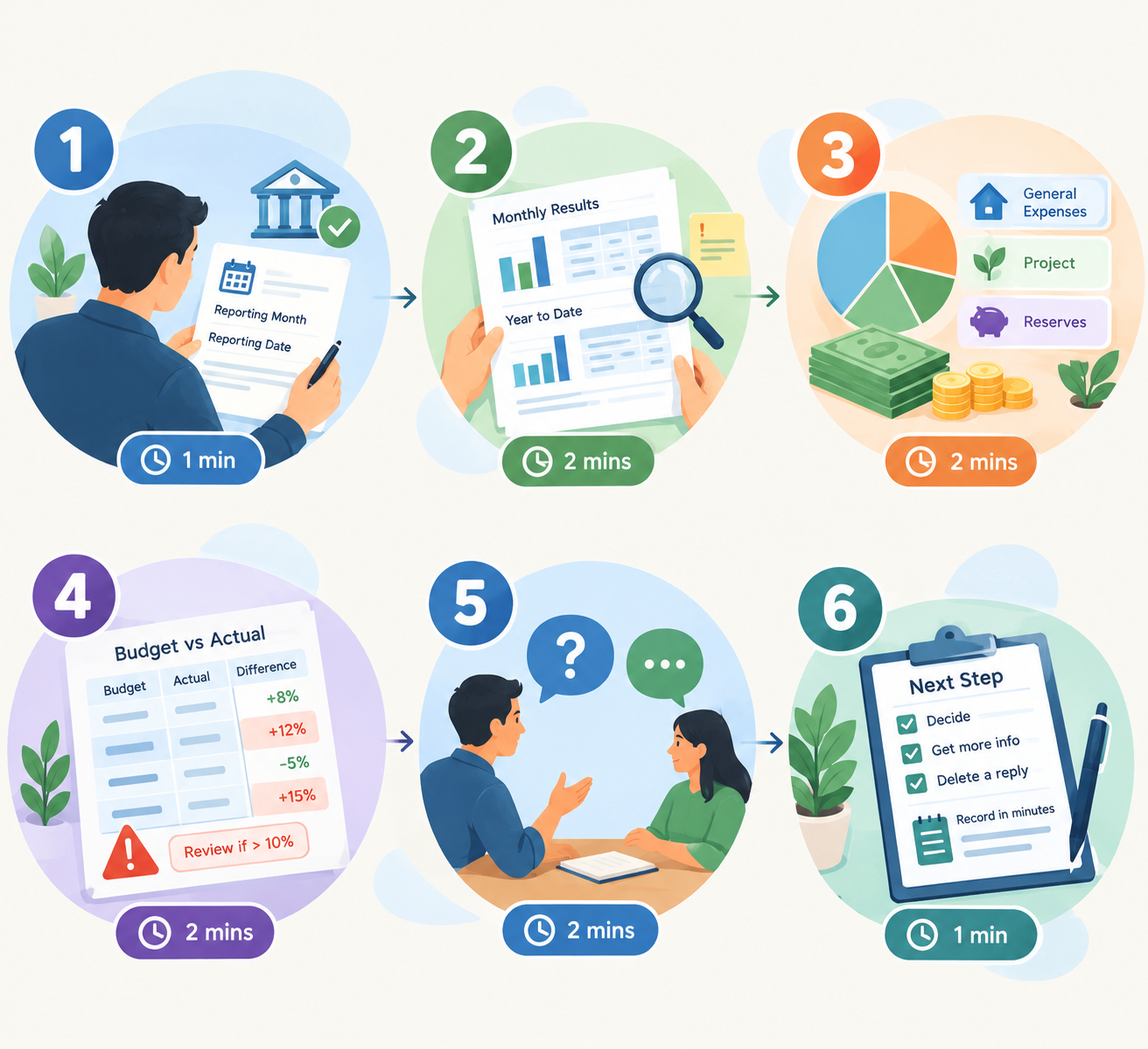
What should the treasurer do at month-end?
The leaders are only able to see what the treasurer has created. A good and reliable routine of a month-end routine looks like this:
-
Record every transaction for the month.
-
Reconcile the bank account with the books.
-
List the income and expense report, as well as check the fund balances.
-
Examine the unusual balances in the fund and ensure that the money being used is not a restricted fund.
-
Write a brief comment in simple language, three to five lines.
-
A week prior to the meeting, give the board the report in writing.
-
File a copy with the minutes.
The week-ahead habit is from a guide to the treasurer's role published by the Free Methodist Church in Canada. It advises sending the monthly treasurer's report in writing to board members a week in advance of the meeting. This allows the board members enough time to carefully consider the figures and come up with valuable questions. For a more general sense of this role, see our guide to the duties and responsibilities of a church treasurer.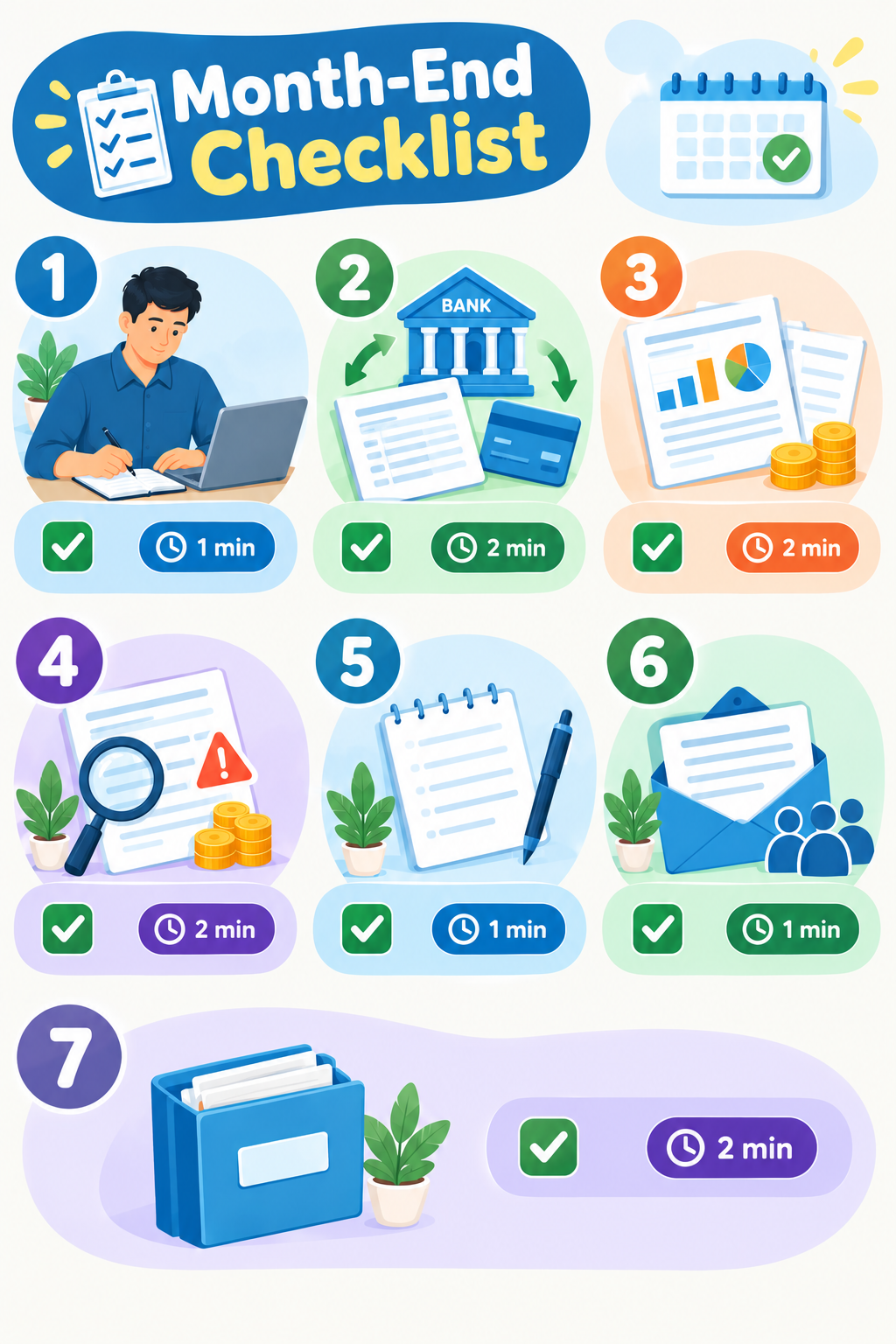
Which warning signs mean it's time to investigate?
The following are the signs:
-
The reports are submitted late or are presented only at the meeting.
-
The reported bank balance cannot be verified against a bank statement.
-
There is only one person who controls the record, with little or no independent examination.
-
Questions are answered with “it’s complicated”, but no supporting numbers or documents.
-
The exact same answer comes up every time, for example, "timing" with no clear answer.
-
Figures for previous months are changed or corrected without a proper explanation
All of these are the reasons for requesting the relevant records and getting an independent review if needed. These indicators do not necessarily imply money has been stolen, but they are worth noting. If the treasurer role is changing hands, our post on church treasurer handover explains what should be handed over.
Frequently asked questions
What financial documents should your church prepare?
A church should prepare a cash and fund balances summaries, cash flows statement, periodical income and expense report and budget versus actual comparison. It could also be required to prepare formal financial statements, if needed and requested for.
How often should the church prepare financial statements?
Monthly reporting is a good benchmark for the board and finance team. Conga congregational summaries can be monthly, quarterly, or yearly based on your governance and reporting requirements.
What is the difference between the statement of activities and statement of financial position?
The statement of activities is a financial statement that reports on the activities, revenues, and expenses for a period of time. The statement of financial position is a financial statement that reports on assets, liabilities, fund balances, or net assets at a specific point in time.
Why can't a church spend its entire bank balance?
Some funds might be restricted. Some funds might be carried forward, as income, to support another building, mission or project. If funds are received or receivable, and have restrictions which must be adhered to, that money should be treated separately from general funds. The bank balance may not include all funds available for expenditure.
What is the most important financial report that a church board should be requesting?
Monthly reviews should include revenue and expenses, compared to the budget, the monthly and year-to-date surplus or deficit, the cash balances available, the balance of the restricted funds, and any special differences.
Is it a must for a tiny church to come up with formal financial statements?
A small church can monitor and present its financial position with a simple monthly report used by leaders. However, it may be obligated to prepare formal financial statements in accordance with the laws, regulations, accounting standards, or denominational rules that are relevant to the church. The church needs to consult a local accountant.

Church Budget: A Practical Guide for Churches
Learn how to create a church budget step by step: estimate income, list costs, add a reserve, and check spending each m…

Jesus quotes: 25 sayings and what they mean
25 Jesus quotes from the Gospels, grouped by famous, love, hope, faith and short sayings, each with its Bible reference…

Church Bookkeeping Made Simple for Beginners
New to church bookkeeping? Learn what to record, how to track funds, and a simple monthly routine that any new treasure…
