
Church Bookkeeping Made Simple for Beginners
New to church bookkeeping? Learn what to record, how to track funds, and a simple monthly routine that any new treasurer can pick up.

Is it possible that the person who is currently responsible for your church finances gets replaced with someone who has no idea about bookkeeping?
In many churches, financial records are kept based on the knowledge, files, and experience of just one person. As a result, it can be challenging to retrace the flow of funds, where they came from, and where exactly they went.
Using church bookkeeping, you can keep an exact record of every transaction with supporting documentation and a clear explanation.
The guide will walk you through the process of organizing finances of your church, recording and tracking donations, expenses, and donations with specific designations.
Main Points:
-
Ensure that all transactions are documented as they occur and supported by appropriate documentation.
-
Set up funds in the accounting system and track their use to ensure their source can be traced.
-
Separate duties for cash counts, recording, and audits.
-
Ensure monthly reconciliations of the finances and investigate any irregularities.
What Is Church Bookkeeping?
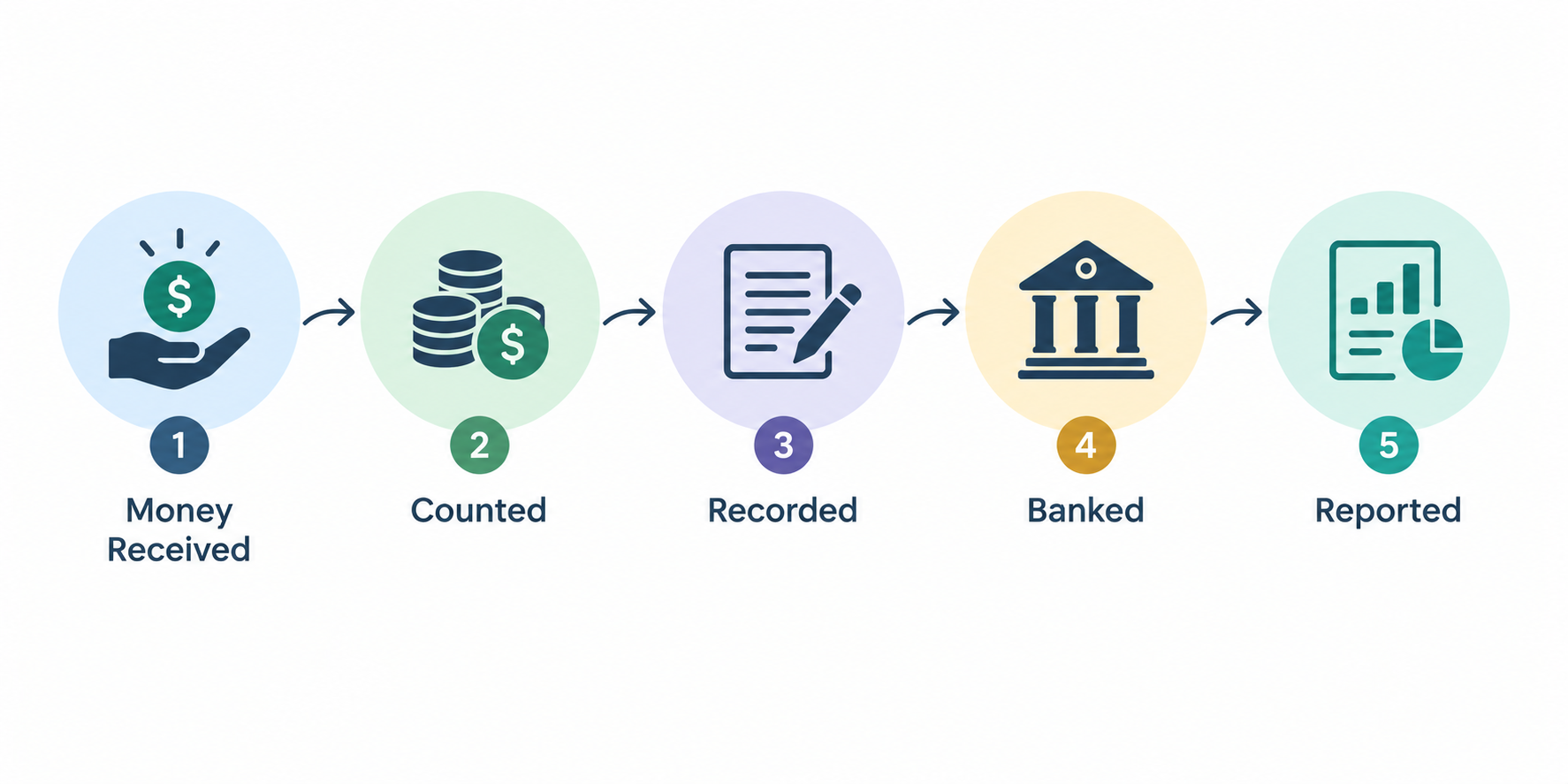
Church bookkeeping deals with the recording of all financial transactions of the church, including offerings, expenditures, salaries, reimbursements, and transfers.
Each transaction has four aspects that shall be recorded:
-
When did the transaction occur?
-
The amount of the transaction.
-
The account or fund to be credited.
-
The bill, receipt, or other documentation that supports the transaction.
Proper bookkeeping enables church leaders to understand their financial situation effectively. It allows them to analyze the income and expenditures of the church. In addition, it helps them control spending and make informed financial decisions based on the facts. Also, it creates informed financial decisions that can help church treasurers and spenders since they do not have to rely solely on memory when explaining the nature of a transaction.
Recalling the question in the beginning: could someone else take over who has no idea about bookkeeping?
In other words, if the church hired a new treasurer, would he or she be able to follow the bookkeeping procedures you currently use? If the answer is no, then your bookkeeping practices need improvement.
Launch your church into the future
Everything your ministry needs — giving, events, members, and more. Try it free, no credit card required.
Start Free Trial No credit card • Cancel anytimeWhat is the difference between church bookkeeping and church accounting?
Both of them are closely related, but they work and serve different purposes. Bookkeeping helps in recording all financial transactions, while accounting uses those records and helps understand the financial position of the church and prepare reports based on it.
|
Category |
Church Bookkeeping |
Church Accounting |
|
Main Purpose |
To accurately record every financial transaction |
Interprets financial information and prepare reports |
|
Person in charge |
Treasurer, secretary, or a trained volunteer |
The accountant, finance expert, or a finance team |
|
When does it happens |
During every transaction, on a daily basis or weekly |
Usually happens in a weekly, monthly, quarterly, or annually |
|
What it produce |
Records of transactions, ledgers, cash book, and receipts |
Church budget, financial statement, and financial analysis |
|
What it help in answering |
Where the money came from and where it went? |
The church financial health |
Accounting depends on bookkeeping as its foundation. If transactions are not properly recorded, missed, or incorrectly recorded, the end report prepared based on those records may be unreliable.
Churches looking to manage this task effectively can take a look at Tabernacle’s church accounting module. It brings both of this in one single place, to let you effectively manage your church finance.
What should a church record?
A church needs to document all matters concerning expenditures or changes in ownership or liabilities. It is enough to provide six categories of this information at a time.
|
Category |
Example |
What to note |
|
Income |
They include income, expenses, transfers, assets, liabilities, and individual giving. |
date, amount, fund, and the person tallying. |
|
Expenses |
for instance, pastor’s support, salaries,and maintenance |
The date, amount, funds, approval, and receipts. |
|
Transfers |
Bank deposits, many moved between them |
need the date, amount, source, and destination. |
|
Assets |
cash, bank deposits, equipment, and land. |
Requires an initial value and the closing value of these items. |
|
liabilities |
Loans, unpaid bills, borrowed money from someone |
Amount owned, person to be paid, due date |
|
Individual giving |
what every member contributed in the tithes and offerings in a year. |
Required for statement and receipts |
These records are essential to a church because they provide documentation of all monetary items and facilitate verifying expenditures and receipts of the church.
Fund accounting made simple 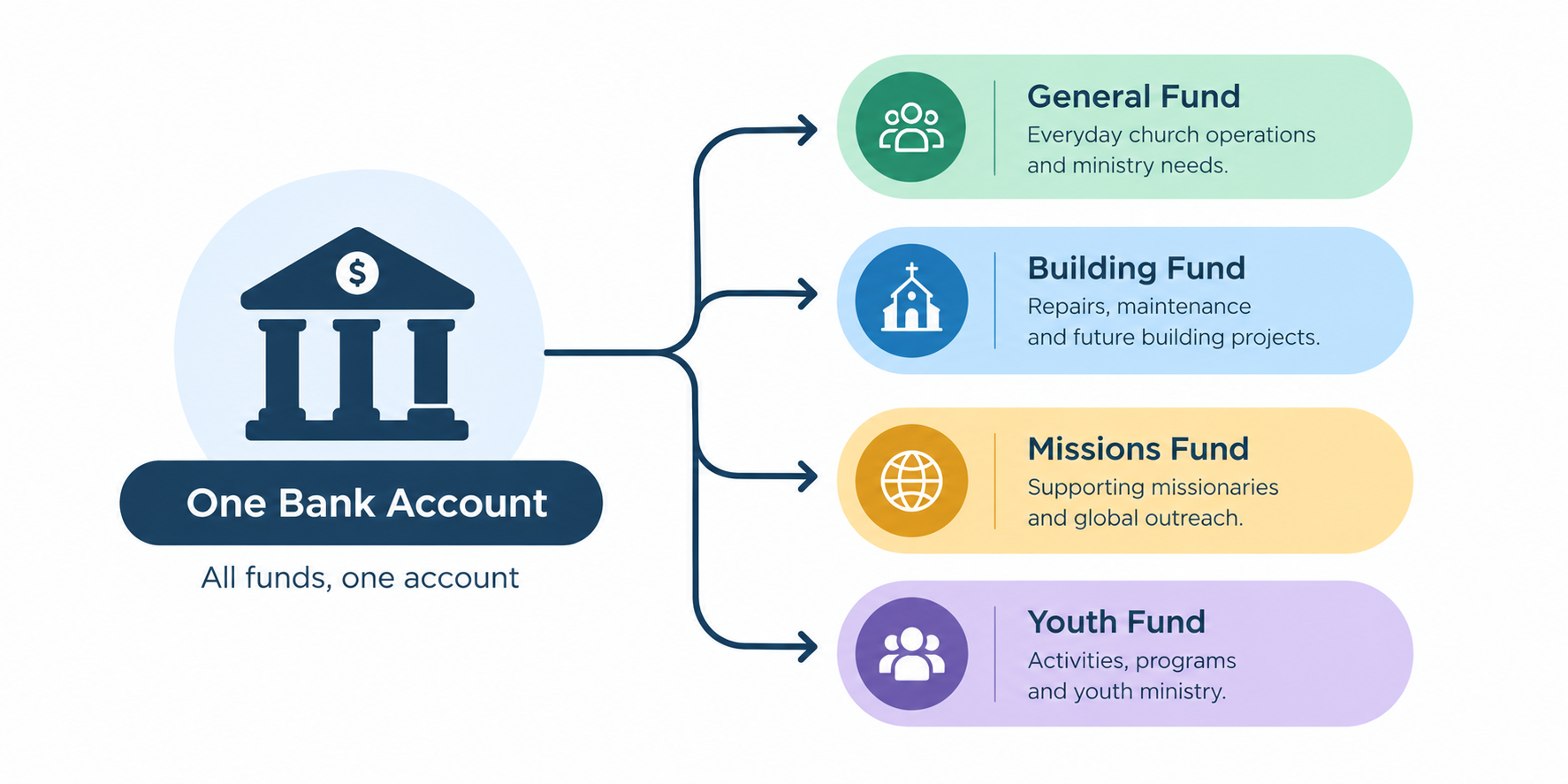
Imagine a family setting aside part of their income for school fees. The school fees go into the same bank account as the rent money, but you don't use that money to pay for groceries. Fund accounting is a way of recording these earmarked amounts of money.
A church may have just one bank account, but it could have a number of funds. They might fund the cost of running the church, have a building fund, spend some of their money on missions work and youth ministry, and so on. Each fund is given a separate running balance in your books.
|
Fund type |
What it means |
Can it be used for anything? |
|
Unrestricted (general) |
Money for any church purpose |
Yes |
|
Restricted |
Given for a stated purpose, such as a building |
No, only that purpose |
|
Designated |
General money that leaders set aside for a purpose |
Yes, leaders can change their decision |
The Church of Scotland's accounting policies identify the same three categories and warn that restricted funds cannot be diverted to unrestricted purposes.
Record the purpose on the day of the donation. A gift of any amount with no attached designation will create a dispute over whether it was intended to be used for building improvements or operating expenses, and the pastor's recollection will differ from the treasurer's.
How to set up church bookkeeping step by step
1. Choose a financial year. For example, India has a financial year that runs from 1 April to 31 March which is also the tax filing period, so set your financial year to match.
2. Set up a church bank account. This keeps your personal funds separate, and adds at least two signatories so no single person can empty the account.
3. Fund listing. List your funds: general, building, missions, and start adding youth, benevolence or any other specific funds only once people start donating to them.
4. Categories. List categories to record expenditure, and keep them brief. If your electricity bill is sometimes categorized as utilities and sometimes as power, you're doing it wrong.
5. Set approval limits. Determine the amount of cash that requires board approval to spend and document it somewhere.
6. Choose a recording medium. Your options are a cash book, an excel sheet or some accounting software. Pick one, and stick to it, because two sets of records will only create confusion.
7. Open balances. Document the bank balance, cash on hand and funds as of the first day of your financial year.
Compile these instructions into a single document and pin it at the front of your account books, where it will remain, hopefully, for years. This is what your auditor will look at first.
The steps for recording donations and expenses
For every offering:
-
Recording of the contribution and having two people count it and also signing the count sheet.
-
The total amount should be separated into types: For example Mission funds, tithes and general offering.
-
The total amount counted should be recorded the same day.
-
Take the donation to the bank and keep the deposit receipt together with the counting sheet.
Regarding expenses:
-
Obtain an invoice or receipt, for small purchases too.
-
Record the name of the person who authorized the purchase
-
Enter expenses into the right fund and category
-
Attach the proof of the expense to a numbered voucher.
Make sure that your count sheets and vouchers are sequentially numbered. A gap in numbering will most certainly raise a flag with a reviewer.
For example, your entries would appear like this (keeping in mind that amounts are just examples).
|
Date |
Description |
Fund |
In |
Out |
Proof |
|
3 Nov |
Sunday offering, counted by two |
General |
₹18,450 |
Count sheet 44 |
|
|
3 Nov |
Building fund gifts |
Building |
₹6,000 |
|
Count sheet 44 |
|
5 Nov |
Electricity bill |
General |
₹5,000 |
Bill, receipt |
|
|
7 Nov |
Youth camp advance |
Youth |
₹2,300 |
Voucher 12 |
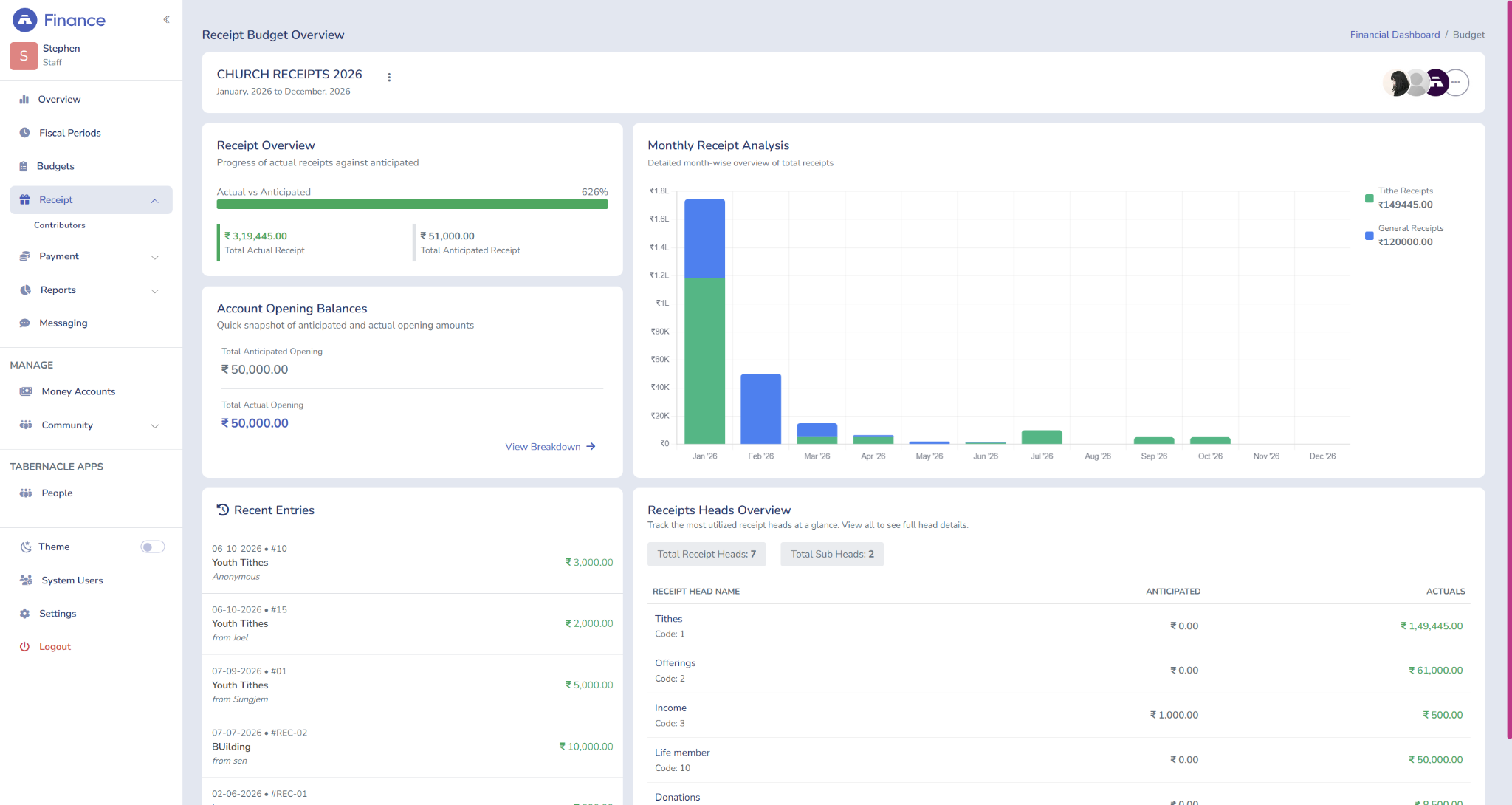
Donations received via bank transfer or the internet should be treated the same way as other donations. You can read the details in our guide for keeping accurate records of church donations. You can also check out how Tabernacle handles giving.
A simple routine for bookkeeping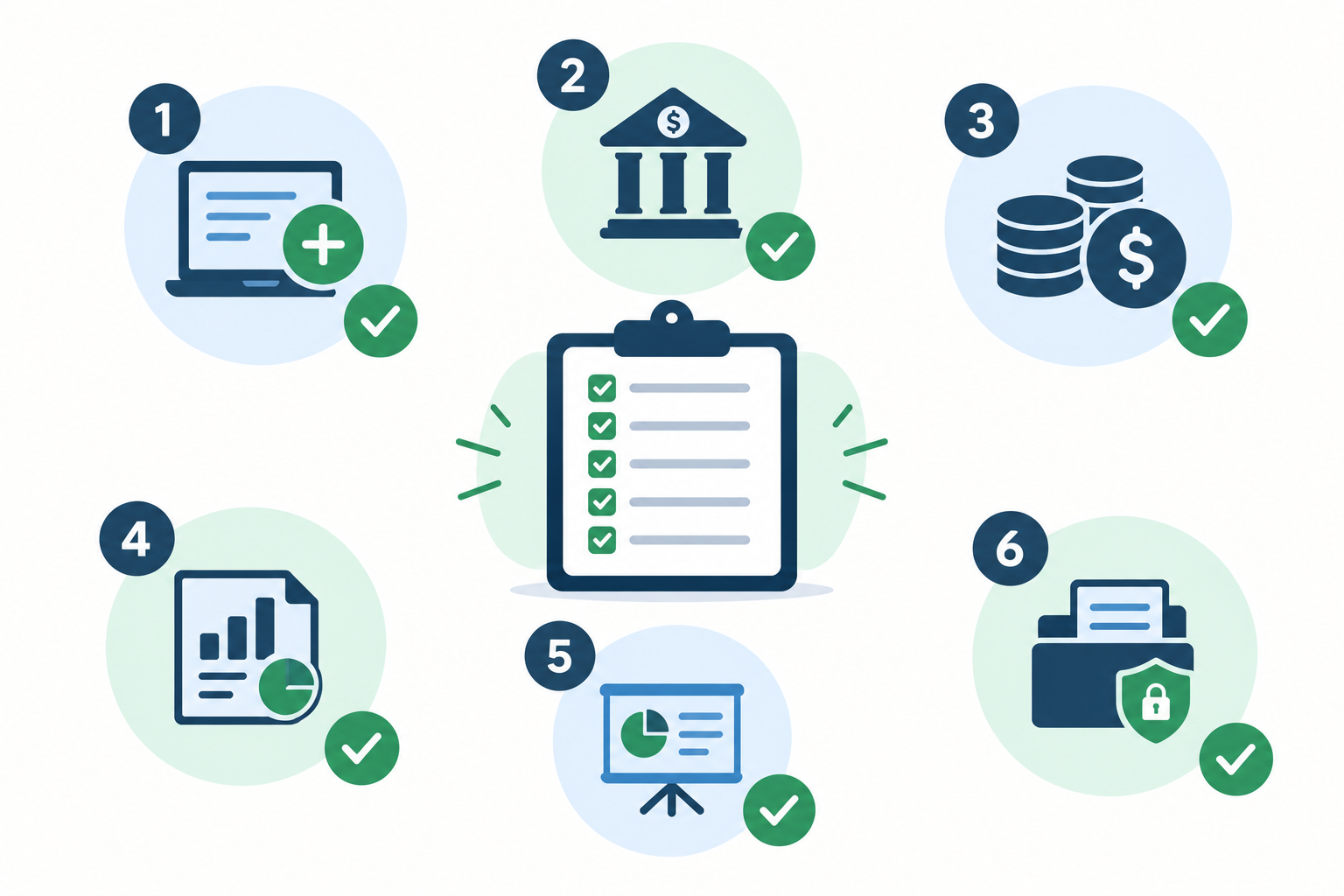
Image to use: Custom checklist graphic with the six monthly steps. Alt text: Monthly church bookkeeping checklist with six steps from entering transactions to backing up records
The monthly rituals in place help keep small mistakes manageable. Block out a certain day once a month and follow this procedure.
|
Step |
What to do |
Designated person |
1 |
Input all pending transactions |
Treasurer |
|
2 |
Reconcile books with the bank statement |
Someone who does not deal with cash |
|
3 |
Check balance of each fund |
Treasurer |
|
4 |
Compare expenditure with budget |
Finance team |
|
5 |
Prepare one-page summary for leadership |
Treasurer |
|
6 |
Store vouchers and back up records |
Treasurer |
Step 2 Matching the statements with the banking institution (step 2), involves confirming each item on the bank statement with an item entered in your records. The discrepancies usually result from some large deposit which the bank has processed but no one has made any entries for, a bank charge which nobody accounted for, or a mistake in entering a figure. If you find different amounts, do not manipulate anything in order to make your accounts match. Note the difference, try to discover its source, and request the help of the reviewer.
After that, conduct the 5 Minute Trace test. Choose any three numbers from your bank statement and trace them back to the company records. If you can do this for all three in a flash, it means that the system is sound. If not, you have found your next task to accomplish.
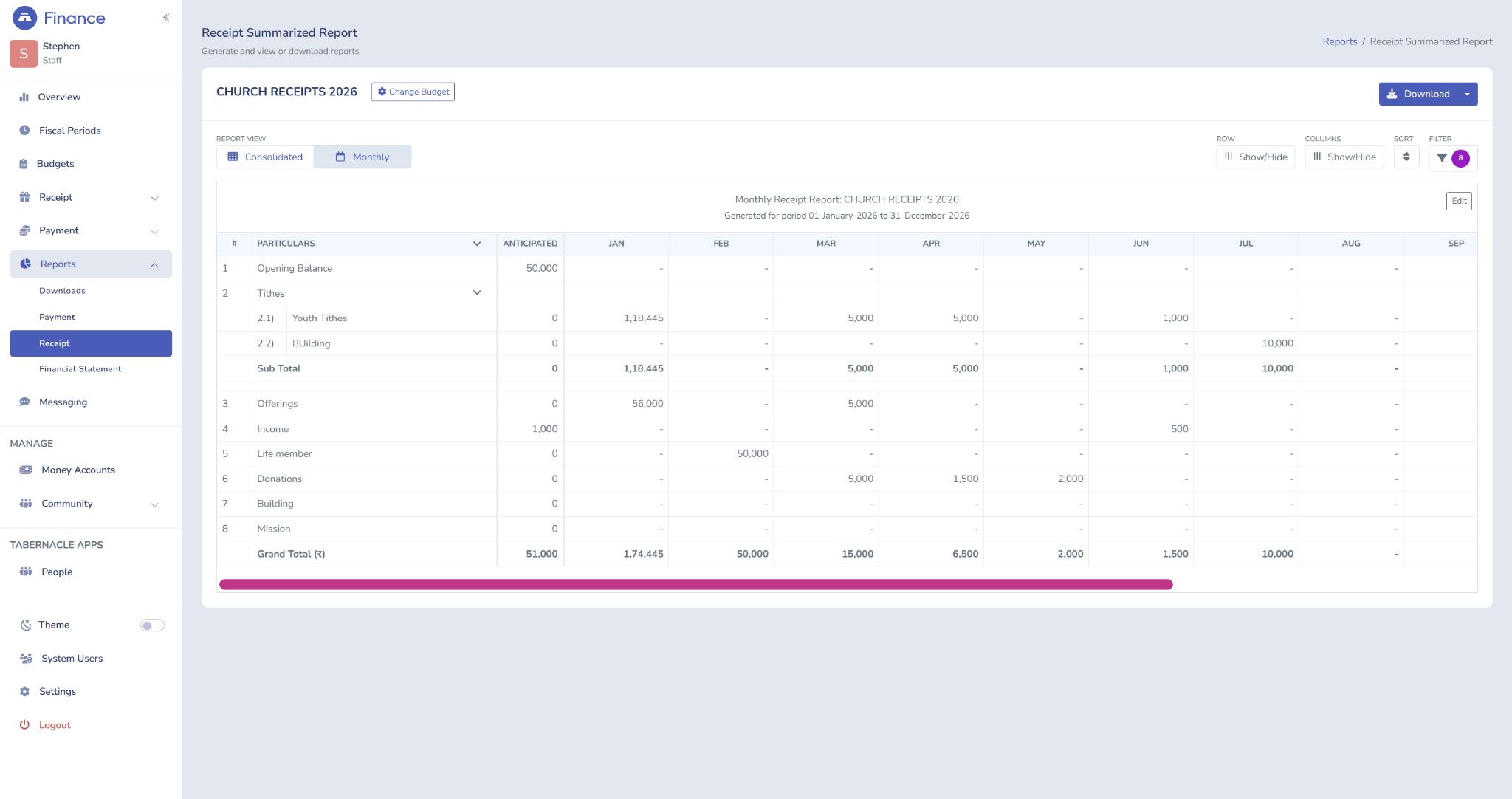
Keep the monthly report to one page: money in, money out, the balance and each fund. Tabernacle's reports produce this kind of summary from entries you have already made.
Who should do the church bookkeeping?
The small church can divide the responsibilities as follow:
-
Counters: two people who are not connected, who will do the counting and signing
-
Treasurer: is the one who records the transactions, makes deposits and payments
-
Reviewer: matches the bank statement to the book balances and does not handle any cash transactions
-
Pastor or board: accepts big payments and gets the reports
There shouldn’t be a single person doing the counting, recording as well as reporting on the same funds. If there are just three people available from the church, make sure to rotate in these roles each few months
Engage a chartered accountant to deal with the annual books and tax problems. In case the church is registered under section 12A, the Income Tax Rules list the books it must keep in Rule 17AA, and your accountant can confirm what applies to you.
For details of the functions done by the church treasurer refer to the guide on the church treasurer’s responsibilities and duties. When the treasurer changes, follow the handover steps so no records get lost.
Choosing Church bookkeeping tools and software
Three options work for most churches.
|
Cash record or cash diary |
Excel spreadsheet |
Church management software |
|
|
Pricing |
Extremely low |
Low |
Subscription |
|
Tracking of donations |
Manual |
Automatic using formulas |
Usually included |
|
Donor Statements |
Manual |
Manual |
Usually included |
|
Handover |
Depends completely on individual |
Depends entirely on file |
Data stored by church |
|
Most suitable for |
Very small churches |
Small churches with one competent volunteer |
Churches with multiple fundraising programs |
Typical mistakes in church bookkeeping avoid
-
Mixing up personal finances and church business. When you use personal money, it can create doubts about the other transactions.
-
Maintaining no record of small transactions. Small amounts of money add up and later turn out to be the most difficult to track.
-
Using donations for building projects or missionary work for regular expenses. The donations given for a specific purpose must not be applied anywhere else.
-
Writing everything down at the end of the year. Over time, things are forgotten and receipts are lost.
-
Keeping the information in the same file with one person. If that person is absent, the church cannot access its financial records anymore.
-
Not checking the transactions every month. Small mistakes accumulate.
This month, fix one of the above practices. At once changing all six of the practices would not be effective.
Frequently Asked Question
What is the process of keeping financial records for a church?
Establish a bank account in the church’s name, inventory available funds, and keep a record of transactions associated with receipts: a signed form for the church’s offering and a numbered form for each expense. At the end of each month, compare records with those of the bank statement and provide church leaders with a report.
What are the tasks of the church bookkeeper?
The job of a church bookkeeper is to keep track of offerings and expenses, keep receipts and reports intact, and have bank statements in agreement with the records every month. In some cases, bookkeepers are responsible for generating reports.
Which method of accounting should a church opt for?
Most often, there is the cash basis of accounting applied: transactions take place when cash is exchanged. Some more developed churches may make use of the accrual basis of accounting. In case of doubt, it is recommended to ask your accountant.
Is it allowed for the church bookkeeper to count the collections of the church? When you are asked, it will be better not to.
Church financial management: where to start
New to church finances? Here is where to start: roles, budgeting, offering counts, controls, records, and reporting, in…

New Security Feature in Tabernacle - Remote Logout
A lost or damage laptop should not mean open access. See how Tabernacle admins can sign users out of devices remotely.
Church Administration: Building an Organised Ministry
Church administration covers records, money, people and meetings. See who in your church handles each part.
