
Church Administration: Building an Organised Ministry
Church administration covers records, money, people and meetings. See who in your church handles each part.
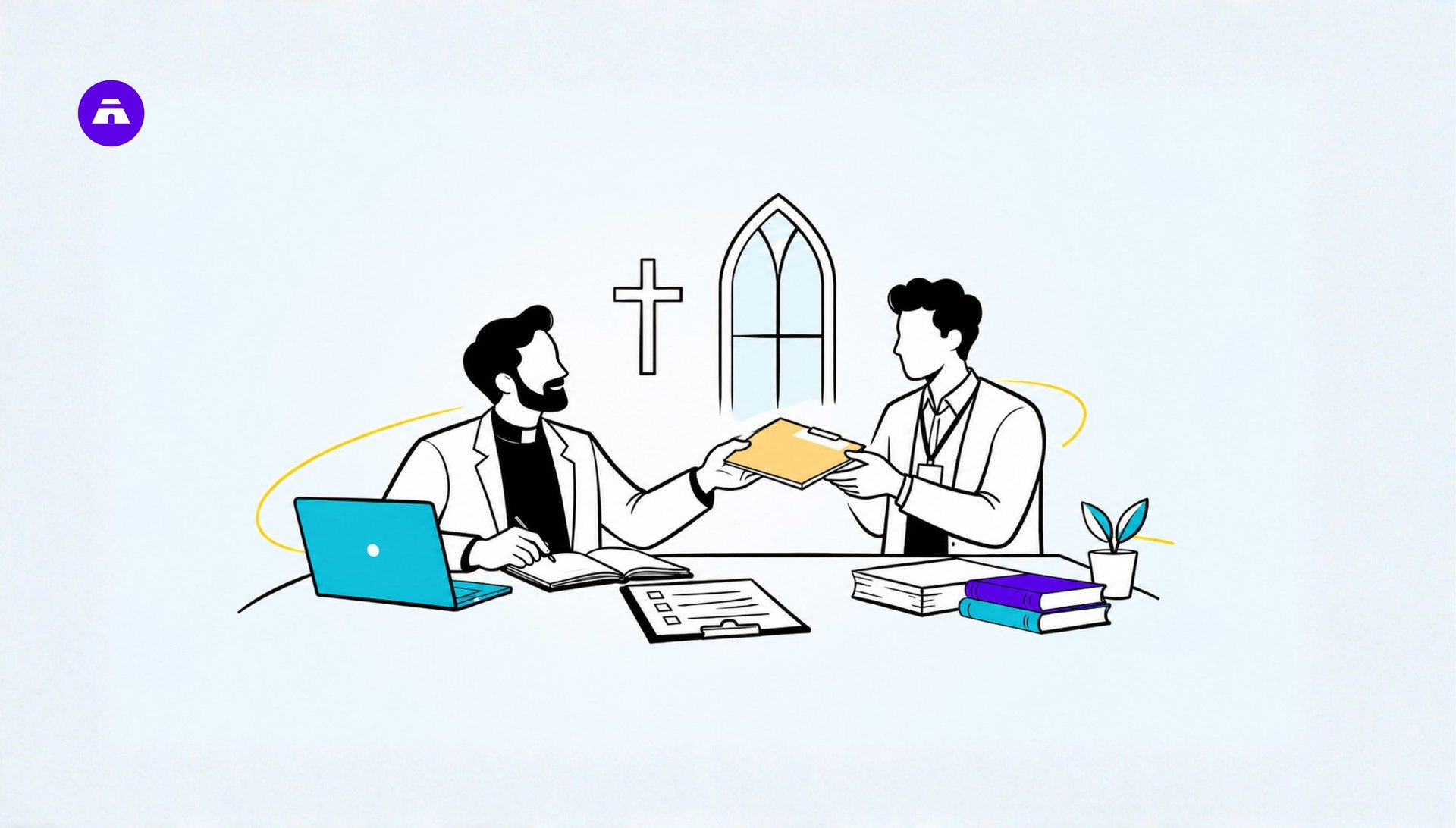
Church administration is the work that helps keep a church organised and running smoothly. It usually includes organizing and maintaining member records, tracking attendance, managing donations and expenses, maintenance of church property, and communication with the congregation.
Acts 6 shows how a leadership team recognized the need to take action regarding an administrative issue that surfaced due to the growing size of the early Christian community. The problem arose when church leaders discovered that certain widows were being neglected in the process of distributing food to the needy. And selected 7 qualified men to oversee the matter.
Launch your church into the future
Everything your ministry needs — giving, events, members, and more. Try it free, no credit card required.
Start Free Trial No credit card • Cancel anytimeThe functions of church administration include the following:
1. Member Records and Attendance
Religious institutions need to have access to the contact records of their members. Based on the requirements of a church, the records can include baptism dates, relationships within the household, membership details, and pastoral care. In this respect, digitization of church records pays off right away.
Such data will allow church authorities to have an accurate picture of their congregation and be able to provide assistance and follow-up when needed.
2. Financial Administration
Financial administration involves recording of donations, tracking of expenses, payment of approved bills, maintenance of bank records and generation of financial reports.
Often the treasurer handles day-to-day financial matters while the church board or other authorized body approves budgets and sets financial policies. The duties of a church treasurer sit here.
Well-defined procedures enable the church to have control over and provide appropriate oversight of donated funds
3. Meetings and Decision-Making
Church boards of directors, committees, and ministry teams typically meet to discuss the affairs of the church, budgets, events, and more.
It is important that someone is appointed to take notes, record decisions made, and keep track of any agreed-upon action items.
Otherwise, it can be difficult for church officials to recall what was decided and who is accountable for what.
4. Staff and Volunteer Coordination
Churches employ professional staff and ministers and volunteers in various capacities.
Administrative and clerical tasks often fall to the professionals and may involve maintaining staff records, coordinating volunteers, assigning tasks and responsibilities and communicating information and instructions to the volunteers. By clarifying roles, you can avoid duplication of effort and ensure that important tasks are not overlooked.
5. Church Properties and Equipment
Church property consists of buildings, furniture, sound equipment, musical instruments, vehicles, keys, and other equipment.
Depending on the church's organization, a property committee, caretaker, administrator, or board may be responsible for upkeep, inventory, access, and other insurance-related matters.
6. Communication
Churches frequently update their congregations about service schedules, announcements regarding prayer meetings, special events, and other ministry activities.
In addition, an authorized person must oversee these communications to guarantee the reliability of the information and that it is shared properly with the intended receiver.
Each area here has to be assigned to one person. When no person is appointed to an area, it becomes neglected.
What information should be maintained by the church?
At the least, the church should hold on to:
|
Record category |
Examples |
Why it matters |
|
Member’s records |
Names and contact information, member directory, baptism records. |
To keep a record of church members |
|
Attendance records |
Church attendance, participation rosters. |
To help the designated officials keep track of attendees and determine needs |
|
Financial records |
Donation records, deposits, expenses, and financial reports. |
To ensure every financial aspect of the church is accountable |
|
Fund records |
Tithes, offerings, building funds, and any other collections in accordance with the official fund records. |
To help the church keep track of all monies collected |
|
Meeting records |
Minutes, decisions, and actions to be taken. |
To keep track of the minutes and responsibilities of every meeting |
|
Property records |
Equipment inventory, maintenance logs, and insurance. |
To keep track of all equipment and property of the church |
|
Staff and volunteer records |
Job descriptions, schedules, and staff files. |
To keep track of all responsibilities and schedules of staff and volunteers |
Churches should be able to keep secure, restrict access to, and take appropriate back-ups of their records. They should also only gather the personal information that they need to do that, and should respect any relevant privacy or record-retention legislation.
Why Accountability and Data Security Matter
In short administrators of places of worship must ensure that finances are kept in order, expenditure monitored, and personal data protected. The information of members should be available only to authorized members of the staff. It is also critical to back up the data against loss and unauthorized access.
Who is responsible for what function in church administration?
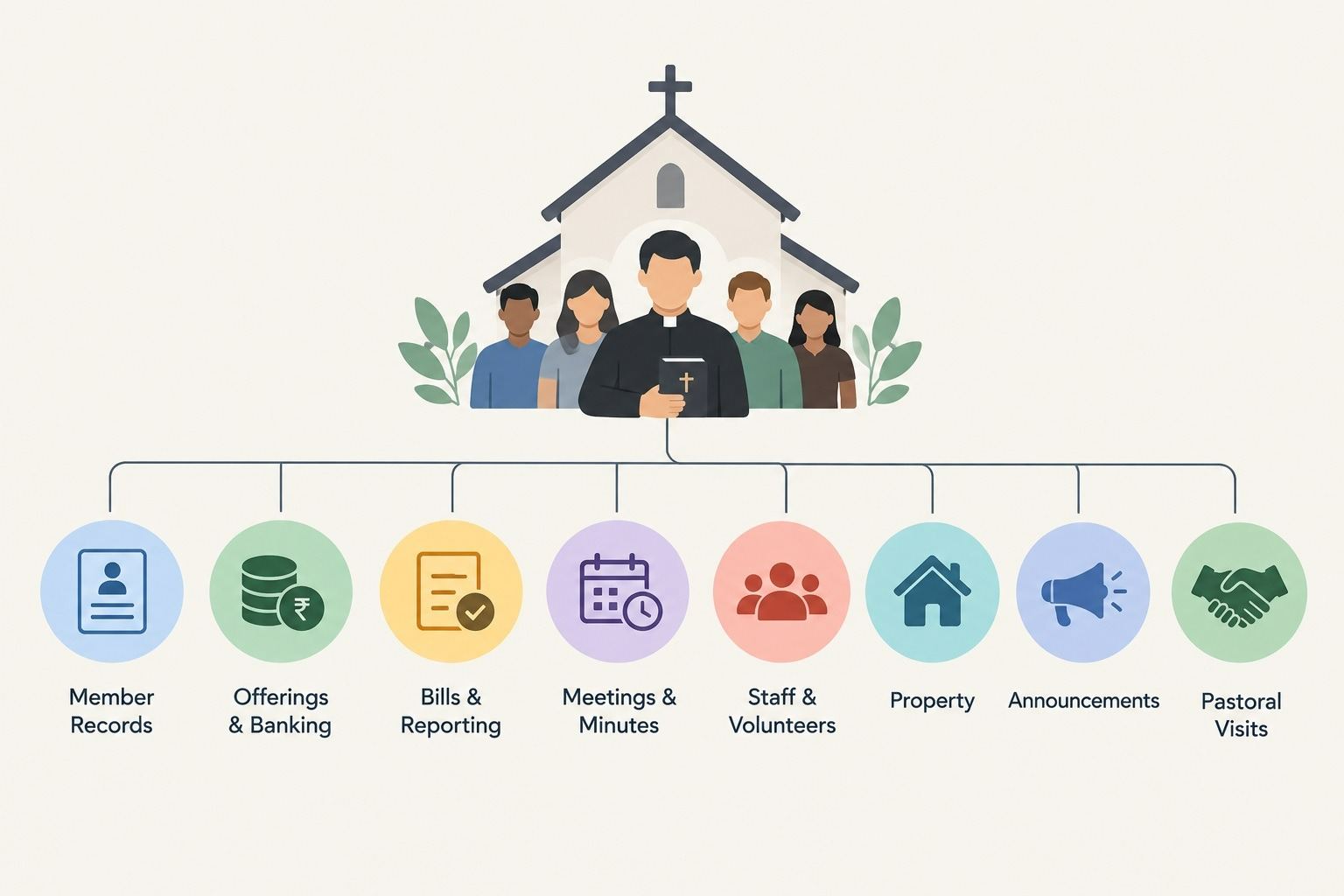
Churches differ from each other in their operations, and your constitution should be checked in this regard. The following structure can be found in most churches:
|
Item |
Who is involved |
Who performs the task |
|
Member Records |
Pastor and the board |
Secretary or the church administrator |
|
Counting and banking donations |
The board lays down the regulations |
Two counters who are unrelated to each other, then the treasurer |
|
Bill payment and reporting |
The board endorses the budget |
The treasurer |
|
Meetings and recording minutes |
Chairperson |
Secretary |
|
Employees and volunteers |
Pastor and the board |
Pastor with a coordinator of volunteers |
|
Property |
The board |
Caretaker or the property committee |
|
Announcement |
Pastor |
Secretary or media volunteer |
|
Visits |
Pastor |
Pastor, elders and visiting groups |
Very frequently in smaller denominations one and the same person stands in the two columns. At such times, an independent reviewer should be brought in for any activity involving finances.
What tasks should a pastor delegate first?
Here is a practical order to follow:
1. Counting and banking of the offering - Two unrelated people count and sign a sheet. One of them makes a deposit. The treasurer records the transaction based on the signed sheet and bank deposit slip. A pastor who handles cash alone can’t do anything else to show that he is innocent.
2. Member record and attendance - One person does the record keeping. Churches that use the Tabernacle keep member records by household, village, colony, and fellowship.
3. Minutes and paperwork - The secretary records all the decisions made at the meetings so nobody has to rely on their memory.
4. Paying bills and reporting every month - The treasurer pays what was approved by the board and submits the report to the board every month.
The pastor maintains the vision and remains the final decision-maker regarding staff, pastoral care, preaching, and prayer. This follows the same model the apostles set in Acts 6.
Whoever carries the responsibility for a certain task has one name inscribed beside the task, and someone who does not execute the task does the checking and gives checks every month.
What happens when no one claims responsibility for the work?
-
Money is snatched from someone's hands. Even an honest person is suspected.
-
People are absent. No one realizes who has been missing.
-
Decisions are lost. Without minutes, the same discussion resurfaces.
-
Information is kept in a single person's mind. Church memory is lost once that person leaves or gets sick.
-
Duplicated work. When responsibilities are unclear, people may find themselves doing the same work, while other work goes undone.
How to implement church administration in a month?
|
Week |
Priority |
Actions |
|
Week 1 |
Assign responsibilities |
List all the significant administrative responsibilities. Delegate them specifying who is in charge and who can approve the results. |
|
Week 2 |
Review financial procedures |
Describe how donations are accounted for, recorded, deposited, and reviewed. Specify relevant control procedures that can be used. |
|
Week 3 |
Organise records and decisions |
Gather the members’ data, minutes of the meetings, attendance lists, and other relevant information. Distribute it by defining the storage rules. |
|
Week 4 |
Review and improve |
Ask an authorised person to assess the quality of financial records and administration. Determine weaknesses and develop the plan for improvement. |
By the end of the month, everyone should know his or her responsibilities, the locations of records, and the methods of review. To the extent possible, have two people count donations, to ensure proper accountability.
What Is the Difference Between Church Administration and Church Management?
The church administration is similar to the church management but not synonymous with it. Church administration involves the process of determining what needs to be accomplished, choosing persons responsible for doing it. Church management is the implementation of what has been decided on a day to day basis.
Can software aid in church administration?
It serves in record-keeping and finance. It will not replace people who check other’s work.
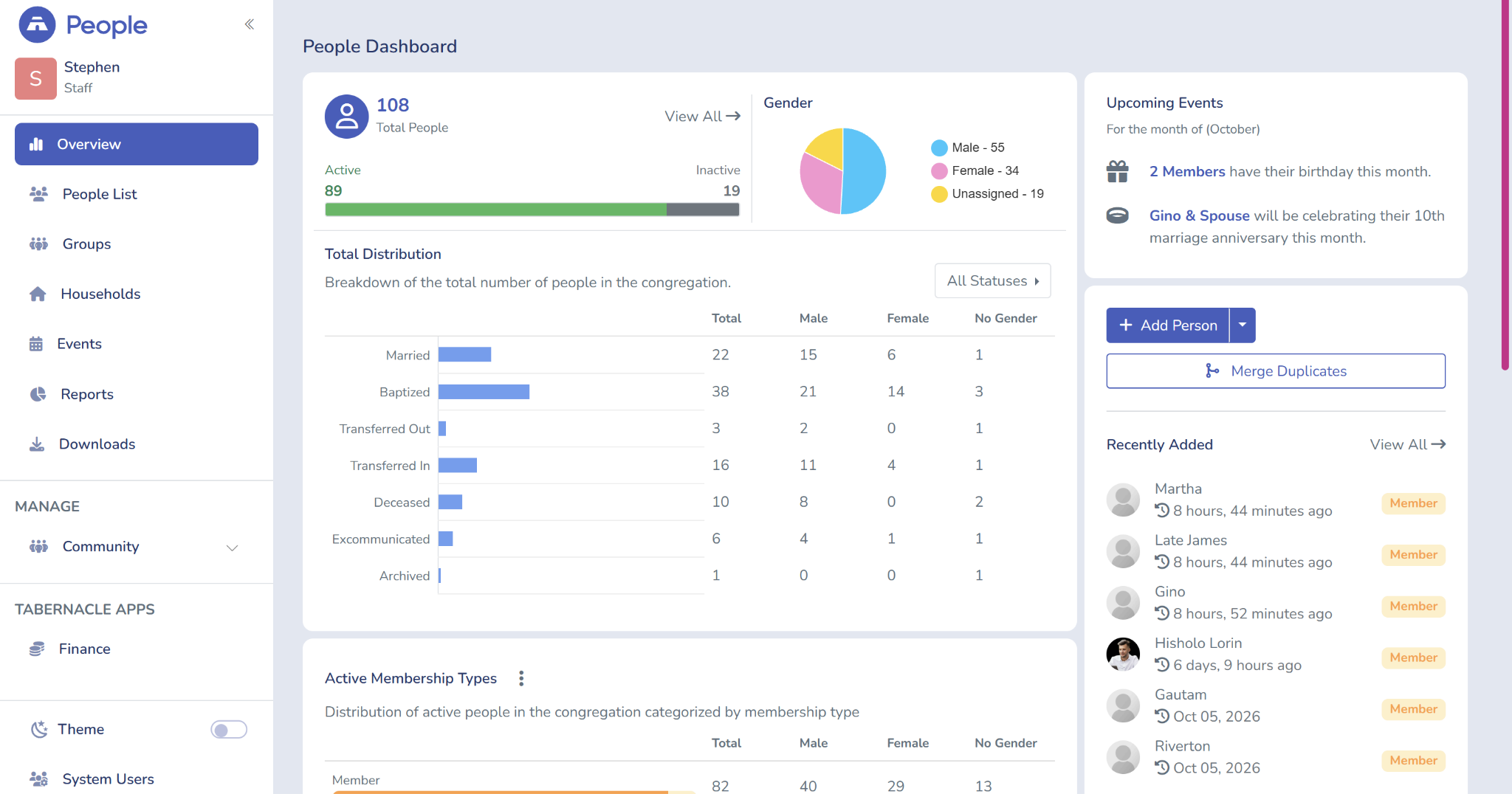
At Tabernacle, the People module keeps member records, attendance and events. The Finance module segregates tithes, offerings, special collections, and building funds and prepares financial statements. Migration of your data from paper, spreadsheets or other software into Tabernacle is free.
Frequently Asked Questions
1. What are the main responsibilities of church administration?
The church administration duties include maintaining member records, taking care of finances, overseeing church meetings, keeping track of attendees, maintaining church property, and handling communication with the congregation.
2. Who is responsible for church administration?
Depending on the church’s size and organizational structure, a pastor, the church board, the treasurer, the secretary, and volunteers can handle administration duties in a church.
3. What tasks should a pastor delegate first?
A Pastor should first delegate maintenance and other clerical duties. For example, they can assign the responsibility for updating member records, minutes of meetings, organizing and coordinating volunteers, and other administrative duties.
4. How can church management software help with administration?
Such software can help keep members’ information organized and up-to-date, track the attendees of various church events, and maintain finances. It can help automate many church administration tasks and make the information easily accessible to those authorized to view it.
Ready to transform your ministry?
Join hundreds of churches using Tabernacle — free for 14 days.

New Security Feature in Tabernacle - Remote Logout
A lost or damage laptop should not mean open access. See how Tabernacle admins can sign users out of devices remotely.

Duties and Responsibilities of a Church Treasurer
A church treasurer records gifts, banks them, pays approved bills and reports to the church. Here are the seven duties …

Church Treasurer Handover: Why Every New Treasurer Starts From Scratch
Most church treasurer handovers fail because records live in one person's head. Here's what actually needs to change ha…
