
Church Treasurer Handover: Why Every New Treasurer Starts From Scratch
Most church treasurer handovers fail because records live in one person's head. Here's what actually needs to change hands, and how to fix it for good

Most new treasurers do not receive a system but rather a box of receipts: a spreadsheet with three mystery sheets, or a binder only the last person could manage to decipher.
Imagine two identical churches.
At the first church, the outgoing treasurer gives the incoming treasurer a bag of paper. "The bank statements are all you need," the old treasurer tells the new one. The new treasurer therefore spends six weeks recreating the books for the last two quarters before beginning his or her own reporting. Preparing for board meetings is postponed since there are no reports available.
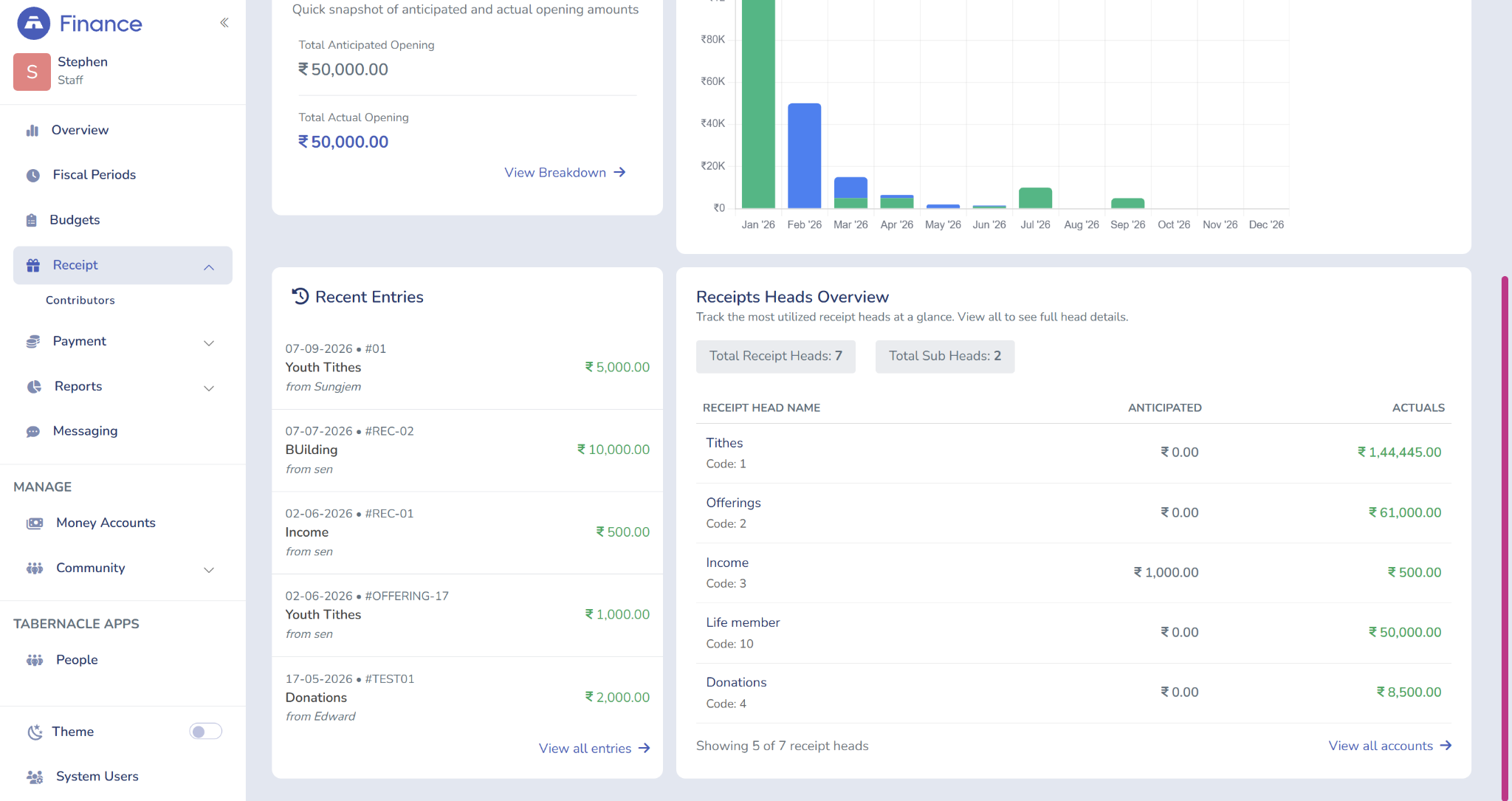
At the other church, the new treasurer is given the same web portal as the former one. There is already a record of all funds and all donations.
Same church. Same size. Different situation.
This difference originates from the poor record-keeping practices of churches of all sizes, even the ones smaller than others.
The distance between good intentions and actual actions is where most volunteer-run organizations fail financially. No one intends to misplace their paperwork. It typically occurs when seasons come and go and your paperwork piles up over time until no one can recall what state things are in anymore.
Why handovers fail
According to MoneyMinder's guide to treasurer transitions, an easy transfer process saves the future Treasurer trouble for years to come while a chaotic process is bound to create nightmares for many years to come. Systems relying solely on one person's memory and conscientiousness stop working the moment that person disappears..
While the fact that treasurers of non-profit organizations are volunteers is not a problem, the problem arises when the whole financial system works only when a particular person is still around to run it. But nobody can run the system forever. People move on, get new jobs, fall ill, or want to take a deserved rest after years of being a volunteer. A non-profit financial structure that is dependent on a single person cannot be called a real system, and it is just a series of favors that are repeated every year without anybody noticing it.
Another major issue with treasury positions is that treasurer rotation takes place much more often than expected, and unlike jobs with paid staff, there is hardly ever a formal handover process. The term of an organization comes to an end, the individual goes for new adventures, and someone just gives up. In this case, the person takes everything they know about the financial system with them.
Common mistakes made at the handover stage:
-
The absence of a proper documented procedure; the treasurer is identified as the "old treasurer."
-
The funds not being accounted for separately; combining the funds, opportunity fund, building fund and missionary fund all together.
-
The receipt books are in a language only understood by the treasurer himself.
-
No record of approval and necessary details of the approval process.
-
The new treasurer tried to figure out the accounts through the bank statements for about six months.
Even with a fully functioning system in place, churches still experience transitions. One guide to nonprofit treasurer transitions notes that when information is spread out, having one bank for checking, another for donations, and a third for reporting makes the transition so much harder than it needs to be. All the parts may exist, but they don't have to.
The takeaway is well worth pondering. Having one program doesn’t make for a smooth transition; it’s all about behavior. However, having the right software and the information you need all in one place makes developing better habits possible.
Launch your church into the future
Everything your ministry needs — giving, events, members, and more. Try it free, no credit card required.
Start Free Trial No credit card • Cancel anytimeWhat it actually costs
Leadership frequently does not see it until it is too late.
-
A board meeting occurs, but it lacks real data
-
A donor inquires about a tax receipt’s incorrect data
-
An accountant charges for excessive hours because the reports do not balance
-
Problems arise at the very beginning that repeat through month number twelve
-
The next finance director inherits an even greater mess
Unfortunately, these issues do not appear as "costs of handover" on a balance sheet. Rather, they appear as a wasted amount of trust, time, and money.
What Transpires During a Handover
Handing over a bundle of documents from the prior to the incoming treasurer isn’t a handover; it just creates confusion. The items that should be passed from the old treasurer to the new one are identifiable and must be documented before the actual transfer begins.
Here are the essential elements that must accompany the transition:
-
Accounts list - This document must contain the descriptions of all funds (offerings, tithes, building fund, missions, special collections) and the records of how each of them operates.
-
Donors list - A history of donations for every member of the organization must be present in the records.
-
Access to the bank accounts - The new treasurer should have access to the accounts as soon as they assume office.
-
Historical records-This information should be stored somewhere other than the personal drive of the outgoing treasurer.
-
Recurring payments -This list must be included in the handover to avoid any failure with the bills auto pay.
In other words, a clear name and aim is designated for each fund, and it can be easily referred to by the leadership. Each donation corresponds to a specific donor, date, and fund rather than being just a figure in a spreadsheet. The receipts are saved in a retrievable system, and the reports can be retrieved whenever needed by making a request.
When can you start and what things should you look into, if no one else did
Not on the outgoing treasurer’s last Sunday; most churches start at this point, so by then it’s too late.
The transition should be started as soon as you suspect it is going to happen, and preferably it should also be started at least one full quarter before the official appointment, so that you can go through one full reporting cycle together with the outgoing treasurer, fix the records that are incorrect or incomplete, and introduce the new treasurer to the bank and the accountant while the previous one is still around.
If no one else has fulfilled these obvious obligations, and now you're walking into the aftermath, here are some of the signs of how dire it is:
-
There's no document showing how the funds are organized
-
Nobody has known when was the last reconciliation
-
Only receipts exist on paper and even then few
-
Only the outgoing treasurer signs for transactions
-
Reports were given "from memory," not as records
None of this is your doing. But this is all yours to attend to and you will be right to mention these issues to leadership early on instead of wasting months cleaning the mess without anybody knowing.
An extended checklist will not solve the problem

Checklists assist in solving problems, but in most cases, if the church does not own a system that can withstand the change of treasurer, the problem will remain unsolved. This is because records can only be transferred as far as the person responsible for it can help, and this is the person who undoubtedly leaves.
This is where digital fund accounting comes into play-where all donations and fund accounting take place in one shared system instead of one person’s account. In this instance, the new treasurer does not have to spend hours figuring out how it all works.
The Church accounting solutions by Tabernacle were created specifically for that purpose-donation history and reports are now stored in a common database instead of someone’s mind.
If you are still in the process of finding alternatives to paper work or spreadsheets, consider learning about what changes this transition brings to churches since this rough transition is often the greatest symptom of big issues the church has.
Making handovers easier
-
Transfer fund information into one file together with treasurer
-
Remember to document and change bank access on the same day as the changes in roles
-
Keep receipts and donations in a digital and searchable format
-
Review financial statements together instead of just transferring them
-
Regularly prepare reports once a month so that one handover doesn’t involve compiling too much information
-
Write down the process of transferring information including the relevant information specifically for the new treasurer
FAQ
What are the duties of a treasurer?
A treasurer records income, tracks the balances of funds, prepares reports, and keeps records in a state that can pass an audit. This is often a volunteer job in a small church but may be paid in a large church with bookkeeping staff.
What is the key component of a treasurer’s handover?
A smooth transfer of fund accounting records, donation history, and bank access without any gap in records stored only in the mind of the outgoing treasurer.
How long does a handover take?
If the records are kept properly, a day; if they are not, weeks of getting information piecemeal from bank statements and paper notes.
When should a church begin planning for the transition?
As soon as a transition seems likely, preferably at least a quarter before the transition. Leaving it to the last week is the leading cause of last-minute rushes.
What distinguishes restricted funds from unrestricted funds?
Restricted funds, for instance, missions offerings or gifts for building funds, are to be allocated for the purpose outlined by the donor. By comparison, unrestricted funds, like general tithes, can be allocated at the discretion of the church. The improper mixing of the two without separate records is among the most common mistakes in handovers.
Do churches need software for this?
Not necessarily, but it prevents an issue of mismanagement. When the records are stored in a single system, it is no longer a problem when a treasurer is replaced; it is just another person taking over records left to him.

How to Keep Church Giving Records Accurate
Most giving record errors don't happen because of bad software. They happen in the counting room. Here's where accuracy…

What Changes When Your Church Switches to Church Software
Thinking about moving off spreadsheets and notebooks? Here's exactly what changes in the office, the finance team, and …

Tabernacle Feature Update: One-Click Contribution Statements and New Tithe Receipt Design
Two updates make church admin a little lighter this month. Contribution statements now go out in a couple of clicks, no…
