
How to Keep Church Giving Records Accurate
Most giving record errors don't happen because of bad software. They happen in the counting room. Here's where accuracy actually breaks down, and how to fix it.

During Sundays, usually a finance volunteer collects the offering and keeps the tally in the records. Weeks later, a treasurer doing the accounting finds that the figures do not match with the actual deposit made. The reasons for this discrepancy have faded into oblivion over time.
At some point it became clear that this is where most of the errors in the recording of donations from the community result from.
Where the errors actually start
Keeping records by hand does not fail because of people being careless. It fails at the same points time again.
-
Unfilled aspect on count sheets later filled through memory or usually not at all
-
Some simple addition errors during manual tallying of totals
-
Loose bills or check without an envelope or information about the donor
-
The use of wrongly placed denomination at time of counting and recording
-
The total amount is used without a proper calculation check the second time.
None of these requires ill intent. It simply happens when the process depends on a single person, oftentimes under pressure, right after service are over
Why the gap between counting and entry matters
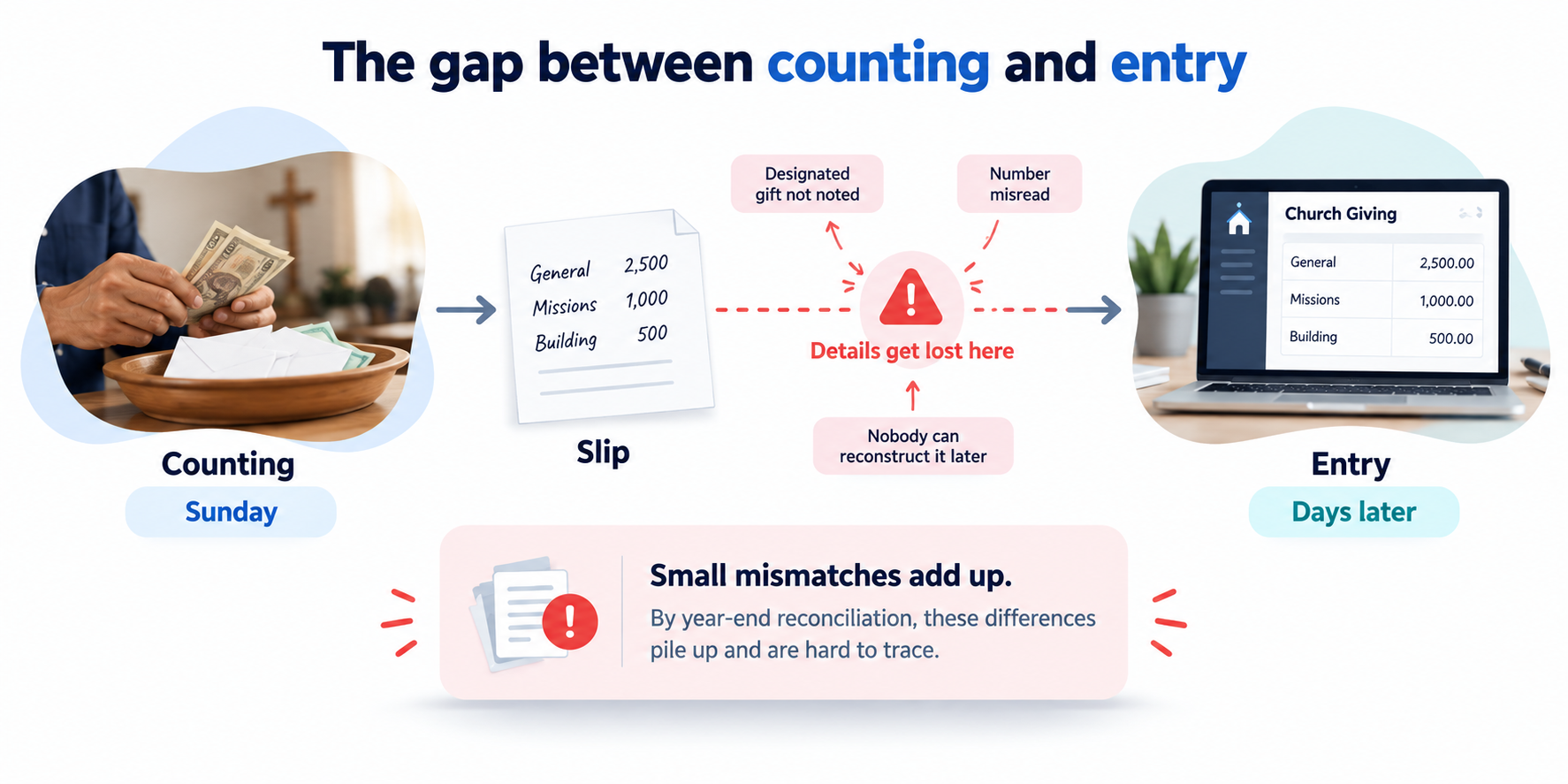
In many church congregations, the person representing the counting activity does not represent the person responsible for data entry. Counting is done on Sunday and the data entry usually takes place several days after that, using a piece of paper as the primary source.
This gap is where most of the details get lost. An important message on a specific donation is not recorded on the paper, mistakes are made, and by that time differences become evident, no one is able to recreate the sequence of events.
This is the main reason which brings a surprising result in the year-end-reconciliation. A small mistake which could have been resolved in 2 minutes has now accumulated and no one knows how to track them.
There is a need for a unique approach towards cash donations
Donations in cash cannot be tracked as easily as checks or even online payments. There is no reference number or bank statement so cash donations may also not leave a paper trail unless somebody created one in advance. It is extremely difficult to keep track of donations that do not come in an envelope.
Here are a number of techniques that can be used to simplify cash counting
-
When counting donated cash it is advisable to count by denomination instead of just giving an estimate of the total amount of donations since this method reduces the chance of making a mistake when counting cash.
-
Always encourage your regular donors to use envelopes even for cash donations. The amount which was brought in cash without an envelope can be later checked against what the person gave before.
-
If cash donations are left without an envelope it is safer to treat these donations as general cash donations from the very beginning since there is no way to find out what they were meant for.
Besides it is especially important for the church since “still” a huge part of the donations are still given in cash.
Fixes where a software is not needed
-
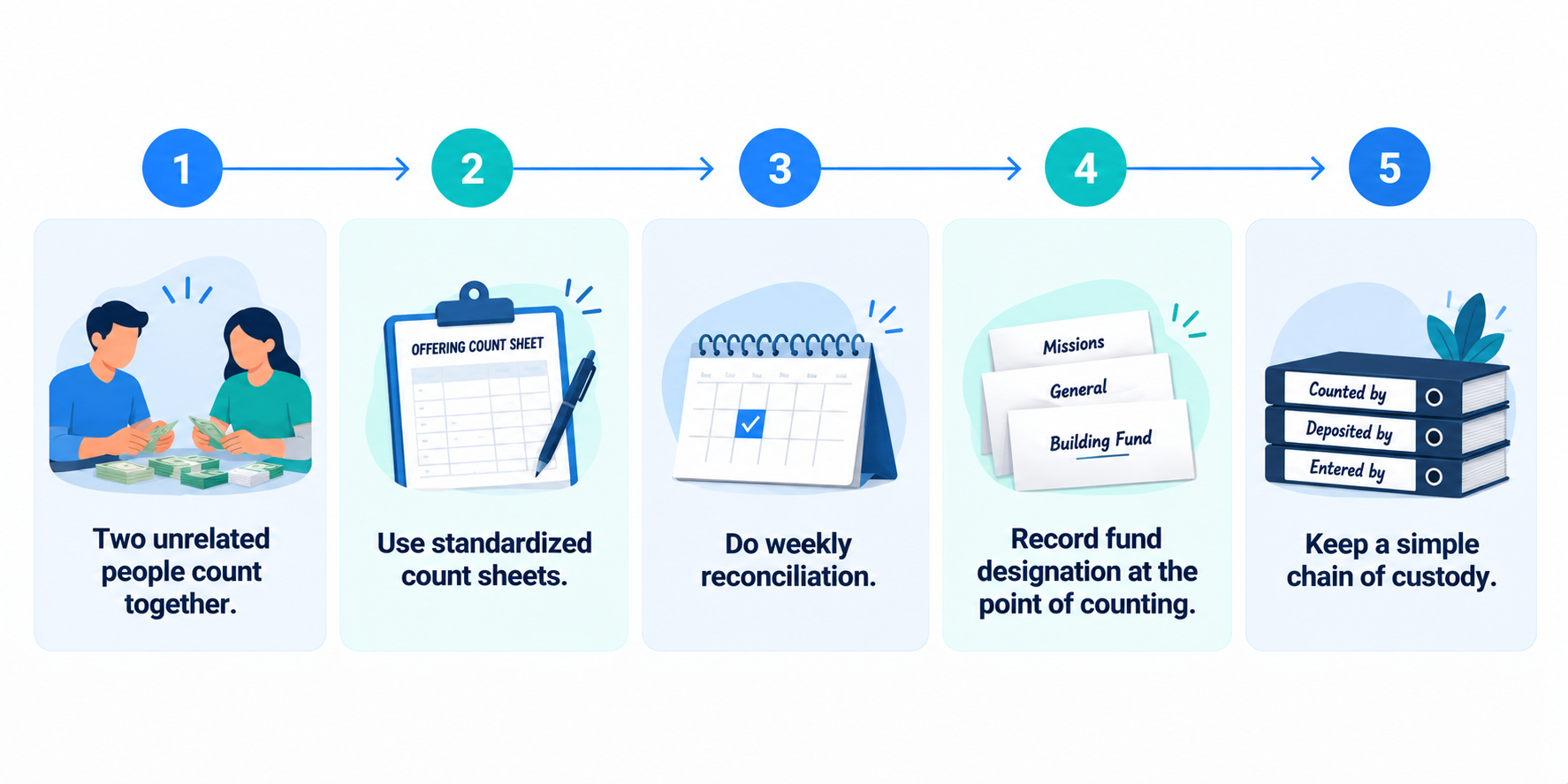
Two-person checking - someone else takes a look at what is being counted and finds miscalculations that were missed by the first person. The National Council of Nonprofits states that having another person who doesn't handle the money go through bank records is one of the easiest ways of ensuring financial security, even for small institutions.
-
Use standard counting sheets to have the same information recorded in the same manner each week, no matter who is counting it.
-
Reconcile weekly instead of waiting for months for things to be done while everyone forgets what was done.
-
Record where the money goes at the time of counting and not depend on someone’s memory. This has to do with proper fund accounting when church donations get recorded as tithes, or offerings, or donations from the very beginning without having to sort it out later.
-
Use a simple chain of custody - by identifying the individuals who counted and deposited funds and those who made the entries to the records so that any discrepancies can be traced to a specific person.
The Rule, based on the solutions above, is quite simple: it is necessary to make decisions right at the time of counting.
Where software comes in handy
Here are some few examples:
-
Software helps in fixing the initial process in handover where specific details are lost while counting and recording
-
Digital Giving eliminates manual entry completely in case donations are made by way of digital transfers as digital transfers allow creating of records instantly when donations are made as information about the donation and donor is available automatically
-
Receipts are generated and sent in a single click without relying on a person to write one out manually
-
A dashboard displays totals and trends, which means there is no need to do any manual number-crunching to determine "how is our performance this month"
The process comes first. In this case, the software enhances a good process by speeding it up and eliminating one point of failure.
FAQ
What is the two-person rule for counting offerings?
Offerings are never handled or counted by one person alone. Two people stay together from collection through deposit.
How many people should be on a counting team?
Donations must always be counted by at least two people working in their own ways.
Should the counter also record the gift?
There should be at least two members of the group involved. However, these should not include those performing the accounting duties after the donation was counted.
Why don't our online giving numbers match our bank deposits?
Usually timing. A gift shows in the platform on one date, the deposit lands a day or two later, sometimes with a fee subtracted.
Should the same volunteers always count?
Though it may not seem like a good idea, constant counting by the same people makes one aware of the weaknesses of the counting system.
Launch your church into the future
Everything your ministry needs — giving, events, members, and more. Try it free, no credit card required.
Start Free Trial No credit card • Cancel anytime
What Changes When Your Church Switches to Church Software
Thinking about moving off spreadsheets and notebooks? Here's exactly what changes in the office, the finance team, and …

Tabernacle Feature Update: One-Click Contribution Statements and New Tithe Receipt Design
Two updates make church admin a little lighter this month. Contribution statements now go out in a couple of clicks, no…

The Future of Church Giving in India: Why More Churches Are Embracing Digital Giving
Digital giving is changing how churches in India manage and receive donations. Discover how digital payments can make g…
